Paris
The Wife He Threw Away: A Billionaire Secret Baby, Marriage-in-Crisis, Second-Chance Grovel RomanceParis is the decisive landscape of Ada Hart’s transformation from a concealed, dispossessed creator into the founder of Maison Cendre. She arrives there carrying pregnancy, grief, very little money, and the refusal to use Sebastian Vale’s fortune. In Paris, bodily vulnerability becomes discipline, sensory perception becomes ownership, and the city’s perfume culture becomes the setting in which Ada rebuilds a life whose name, work, and future can no longer be reassigned by Vale Group.
Exile and Material Survival
Paris first appears as indifferent rather than consoling. In the Marais, Ada is sick every morning over a chipped sink, with nausea that has become a permanent tenant. She has only eleven hundred euros left and refuses to touch the joint accounts containing seven figures of Vale money, because every euro bears Sebastian’s name and accepting it would preserve the dependence she has fled. Instead, she rents a sixth-floor room without a lift and sells the jasmine earrings Sebastian gave her after Grasse for the deposit. The pawnbroker on the rue de Turenne pays ninety euros for the small gold blossoms, and Ada experiences the loss as an austere form of victory: she has become poorer, but the money is hers.
Her walks give this precarious existence a second language. She reads Paris by scent rather than by street signs, registering figs and diesel on the rue de Bretagne, the mineral breath of the Seine near the Pont Marie, and the butter and burnt sugar escaping from a boulangerie. She cannot afford what she smells, but she can name it, and naming becomes a form of possession that no marriage, account, or corporate signature can revoke. The city is beautiful and does not love her back; precisely for that reason, it feels safer than beautiful things that once appeared to love her and demanded a price.
The Atelier and the Making of Maison Cendre
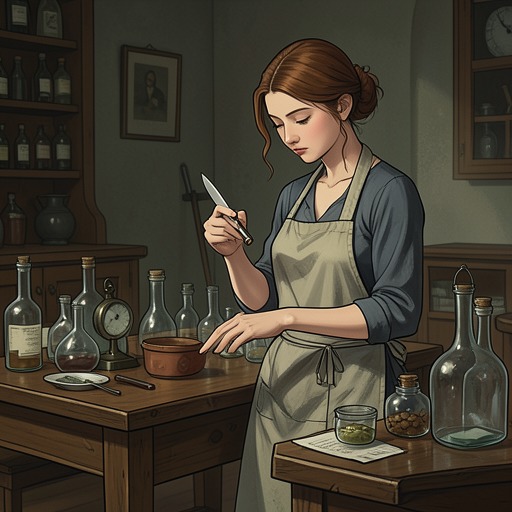
Paris provides Ada with a professional refuge through Estelle. Above the atelier is a cold cot, beneath which the workshop’s smells rise through the floor; the organ belongs to Ada each morning before Estelle wakes. Estelle does not force Ada to disclose the name she has abandoned or the story she is concealing. She asks only for one true thing, recognizing that a nose like Ada’s must have come from somewhere it had to leave. The offer turns shelter into apprenticeship and gives Ada access to the practical instrument through which her buried ability can become independent work.
Estelle later gives Ada her old organ, the two-hundred-tier bench on which she built her early compositions, and tells her only to finish the work. Ada completes it and names the house Maison Cendre. The name defines her Parisian philosophy: Cendre is not the fire but what the fire could not take. The house will burn away sweetness, decorative top notes, and the lie attached to the field in Grasse, preserving only what survives destruction. Paris therefore becomes more than a refuge from Vale Group; it becomes the place where loss is converted into an aesthetic and an operating principle.
The first fragrance Ada creates under the Maison Cendre name is Revenant, built from smoked iris, cold stone, something green and unkillable, and a base of ash and cedar. Its reception is initially intimate and improvised. Delphine Cross sells the first two hundred flacons by hand in back rooms of shops that refuse to place the fragrance in their windows. After a woman wears it to the opera and a critic describes smelling the future of French perfumery on a stranger’s throat, demand grows into a waitlist by autumn. By the second year, Paris has decided that Maison Cendre is the house that refused it, and the city’s inability to bear refusal helps make the house successful.
Authorship, Secrecy, and Commercial Power
Ada deliberately remains absent from Parisian publicity. She uses the public name Adeline Rousseau, her mother’s maiden name, which Vale Group has never touched. She avoids parties and photographs, allowing the press to invent a reclusive, difficult ghost. That invented figure functions as a wall between the public and Theo Hart, the copper-headed boy sleeping in the next room. The concealment is not simply personal secrecy: it protects a child and preserves the conditions under which Maison Cendre can grow without Sebastian or Vale Group immediately reclaiming its founder.
Unlike the launch of Éternel, where Chloe Beaumont is publicly presented as creator while Ada’s work is transferred to another woman’s name, Maison Cendre makes authorship visible on every flacon, ledger, and line of press. The label reads “A. Rousseau.” Ada refuses a muse, a public face in white, and any arrangement in which another person’s name occupies the place her own work has earned. Paris thus becomes the testing ground for a new commercial rule: the product is not separable from the creator’s right to be named, and recognition is treated as part of the house’s value rather than as decoration added after the formula is complete.
Delphine takes the external world so Ada can remain at the bench. She handles buyers, profiles, and men investigating a fragrance house run by two women without a dynasty behind them, while Ada works with Estelle’s organ and builds. Their partnership allows Maison Cendre to expand quietly and evenly, like ash settling into everything. Paris supplies both the skeptical market that initially excludes the house and the cultural pressure that turns exclusion into legend.
Return, Confrontation, and Corporate Rewriting
Paris eventually draws Sebastian back toward Ada. When Vale Group’s fragrance arm falls forty percent year over year and Maison Cendre sells out across three continents in a weekend, the Paris house becomes the competitor Vale Group cannot dismiss. Sebastian proposes acquisition because Maison Cendre is doing what Éternel once did: making consumers press a wrist to the face and travel into personal history. He wants to own the nose he cannot name, defeat, or stop thinking about. His private jet crosses the nine hundred kilometers toward Paris, and he arrives personally rather than sending a deputy.
His appearance at Maison Cendre’s atelier collapses four years of separation. He enters not with a delegation in dark suits but alone, standing among Ada’s copper stills and racked blotters in a room filled with the work of the life she built from their wreckage. Ada permits only a limited commercial possibility: Maison Cendre and Vale Group may conduct business through distribution, a house account, contracts, and lawyers at arm’s length. But the pursuit, flowers, bought-out restaurant, and waiting outside Theo’s school must stop. The wife is not a negotiable asset, because Sebastian has already thrown her out. Paris is where the language of acquisition is forced to confront a person who can refuse the buyer.
At a Federation gala honoring Maison Cendre, Chloe appears beside Sebastian in white while the screen still identifies her as the creator of Éternel. The old lie continues to circulate in a room now orbiting Ada’s house. Chloe performs the familiar gesture of pressing a hand to her chest for photographers, but Ada can identify the note Chloe would mishandle if given a blotter. The contrast makes Paris a site of reputational reversal: the woman once erased beneath a spotlight now owns the institution being celebrated, while the woman who received Ada’s credit remains attached to an increasingly unstable story.
Ada later proposes not destruction but a merger of equals between Maison Cendre and Vale Group’s fragrance division. Her formulas and name must appear publicly and permanently in the founding documents, Chloe’s name must be removed from the Éternel materials, and Ada must hold fifty-one percent control of the division bearing her perfumes. The terms rewrite the economic relationship that Paris made possible. Ada no longer needs Vale Group’s money, distribution, or permission badly enough to surrender authorship; she can enter the negotiation with a viable house, a protected name, and the power to say no.
Domestic Continuity and Narrative Significance
By the later Paris scenes, the city has changed from a place of nausea, cold tile, pawned jewelry, and rented rooms into the setting of ordinary family life. In the garden, Theo learns to draw a recognizable lion on an ordinary Tuesday. Morning light falls through the tall windows of the house on Rue des Saints-Pères onto a kitchen table where coffee waits and Theo kneels on a chair, crayon in hand, concentrating over his drawing. This domestic image completes Paris’s transformation: the city that once received Ada as an impoverished fugitive now holds the child she protected and the household she has built.
Paris’s significance lies in its refusal to become a simple sanctuary. It does not love Ada, rescue her, or erase the consequences of the gala. Instead, its indifference gives her room to exchange dependence for skill, inherited wealth for earned value, and a stolen public identity for authorship that can be written into law. The city’s streets, ateliers, markets, and homes form the material sequence through which Ada moves from survival to ownership. Maison Cendre’s rise is therefore inseparable from Paris: the house becomes powerful because the city first gives Ada a place where what survived the fire can be named, made, and defended.